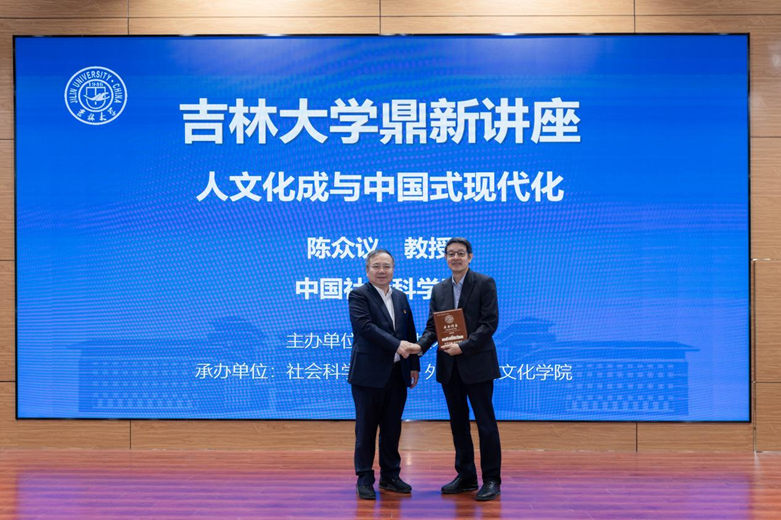
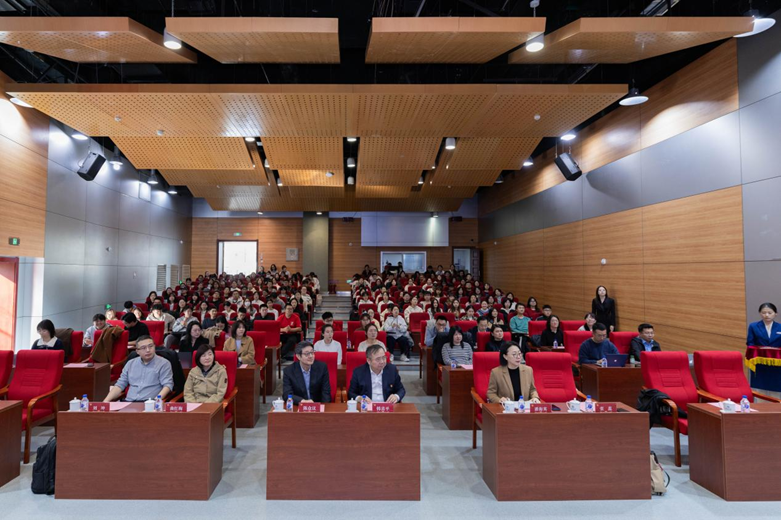
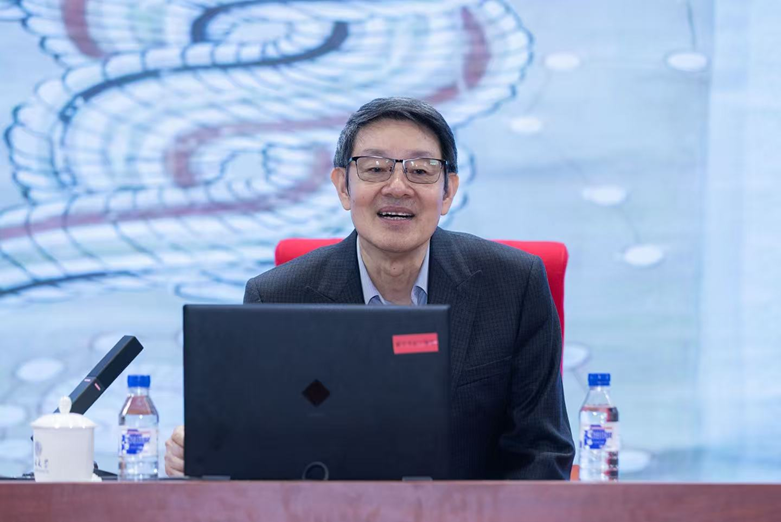
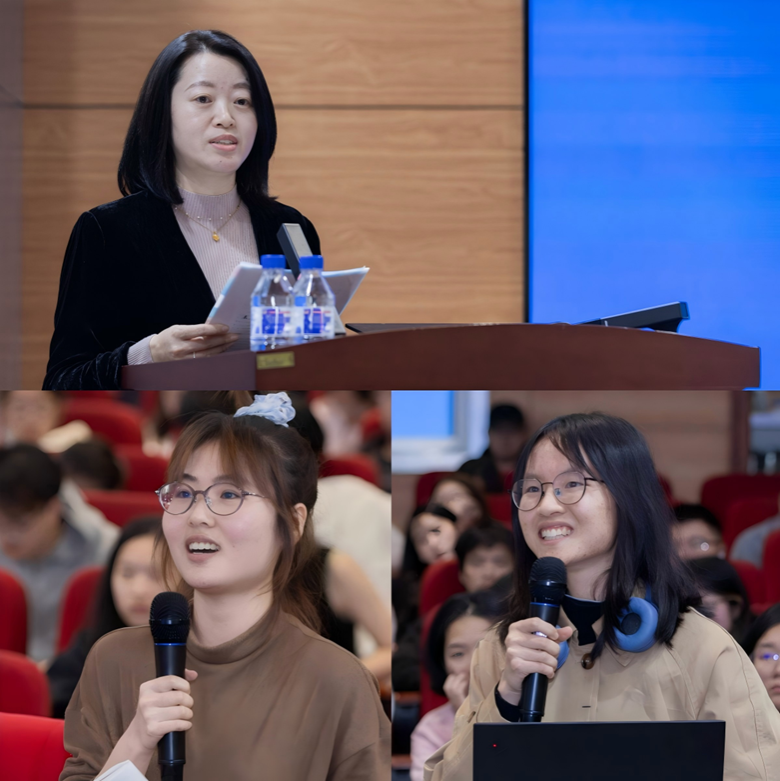
Professor Chen Zhongyi, Member of the Academic Divisions of the Chinese Academy of Social Sciences and National First-Class Professor of Philosophy and Social Sciences, delivered a lecture titled “Humanistic Cultivation and Chinese Modernization” for Jilin University’s Dingxin Lectures on October 10, 2025. Professor Han Xiping, Deputy Party Secretary of Jilin University, attended the event and presented Professor Chen with a Dingxin Lecture commemorative plaque. The lecture was hosted by Professor Zhang Rui, Vice Dean of the School of Foreign Languages and Cultures
Professor Chen opened his lecture with a discussion of the development of the humanities and social sciences as a disciplinary system. Placing the topic within the broader context of national strategy and social development, he reviewed the historical role of the humanities and emphasized their enduring importance. The humanities and social sciences, he noted, are not only concerned with the accumulation of knowledge and the continuation of education, but also carry the mission of preserving cultural heritage and providing value guidance for national development. They embody the spiritual sovereignty of a country and a nation, reflecting the depth of its spirit and the height of its culture.
The lecture then turned to the ancient Chinese classic Zhouyi (Book of Changes), through which Professor Chen traced the intellectual roots of Chinese civilization. He explained that, thousands of years ago, the author of Zhouyi had already developed a dialectical mode of thinking through distinctions such as “nature” and “human culture”, as well as paired concepts including “yin and yang”, “qian and kun”, and “Dao and qi”. These ideas, he argued, laid an epistemological and methodological foundation for traditional Chinese natural philosophy and humanistic practice. Over the centuries, this mode of thought has shaped the trajectory of Chinese civilization and formed a distinctive Chinese way of understanding both the world and the self.
Building on the dialectical unity of “Dao and qi”, Professor Chen further discussed the spiritual foundations of Chinese modernization. He suggested that its future development depends on maintaining a balance between ideas and tools, spirit and method. Chinese modernization, he emphasized, should not be understood simply as material growth. Rather, it involves the all-round development of the human person, a harmonious and well-ordered society, and an ethical commitment to coexistence and shared prosperity with nature. China’s long cultural tradition, he added, gives Chinese modernization its own spiritual markers and value coordinates, shaping a humanistic ethos and an inclusive vision of “tianxia” distinct from Western models.
Rich in ideas and wide in scope, the lecture moved between classical and contemporary thought and between Chinese and global perspectives. It offered a vivid interpretation of “humanistic cultivation” and “cultivating people through culture”, while providing a distinctive humanistic perspective for understanding Chinese modernization.
During the interactive session, Professor Chen responded to questions on topics including how Chinese culture can be more effectively incorporated into foreign literature studies and how classics such as the Zhouyi may inform the practice of Chinese modernization. He encouraged scholars of foreign literature to ground their research in Chinese culture, engage global discourses through Chinese intellectual resources, and develop a research paradigm marked by both academic depth and cultural subjectivity.
Sponsored by the Association for Science and Technology of Jilin University and organized by the Institute of Social Sciences and the School of Foreign Languages and Cultures, this session of the Dingxin Lectures was attended by representatives from relevant university units, as well as faculty and student representatives from the School of Foreign Languages and Cultures.